




Our Commitment to Supporting Vulnerable Young People Across WA
We are incredibly proud and deeply honoured to be delivering three transformative projects—My Voice Matters, Pathway to Healing, and the Starship Project—each designed to strengthen safety, wellbeing, and access to affirming support for some of Western Australia’s most vulnerable children, young people, and community members.
Together, these initiatives expand trauma-informed, disability-affirming, and gender-affirming services across the state. They create safe spaces for healing, connection, and empowerment, while building the capability of the workforce and strengthening pathways to care for those who often face the greatest barriers to support.
My Voice Matters offers creative, trauma-informed art therapy for children and young people with disability who have experienced abuse or sexual violence. Pathway to Healing expands specialist therapeutic services for children and young people with disability impacted by sexual abuse or displaying harmful sexual behaviours, alongside wrap-around family support and workforce development. The Starship Project strengthens gender-affirming healthcare pathways for trans and gender diverse people with disability in regional WA, building local capability and co-designing inclusive practice tools.
Across all three projects, our focus is on delivering safe, inclusive, culturally responsive, and empowering supports—designed with communities, not just for them. We are excited to have the opportunity to lead this work and to contribute to meaningful, long-term change for young people who deserve nothing less than care that affirms their identity, honours their experiences, and amplifies their voice.
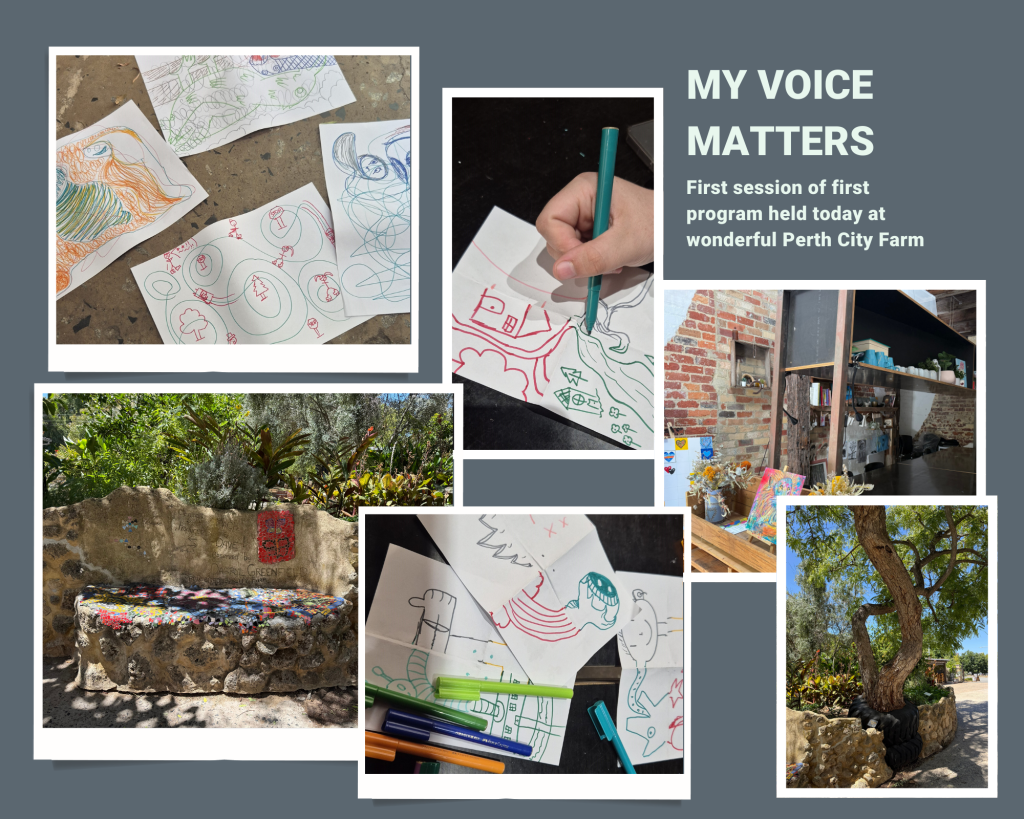
Sponsored by Telethon, My Voice Matters is a trauma‑informed art therapy program
designed for children and young people with disability who have experienced abuse or
sexual violence. The program provides a safe, creative, and empowering space where
participants can explore wellbeing, body safety, relationships, identity, and grief
through expressive art‑making.
Delivered over six weeks in three Perth‑based locations, the program supports young
people to build emotional literacy, confidence, and help‑seeking skills within a
supportive group environment. Each session is facilitated by trained art therapists using
gentle, strengths‑based approaches that honour each participant’s voice, autonomy,
and lived experience.
Across the program, young people are encouraged to express themselves in ways that
feel right for them—through colour, movement, storytelling, and creative exploration—
while connecting with peers who share similar experiences. The focus is on healing,
empowerment, and reclaiming personal agency.
The following programs have been scheduled for 2026:
Perth:
19 February 2026
6 May 2026
5 July 2026
14 October 2026
Venue: Perth City Farm
Rockingham:
9 April 2026
15 October 2026
Venue: South Coastal Health and Community Services
Joondalup:
25 March 2026
30 July 2026
Venue: ECU Business & Innovation Centre
Mandurah:
28 May 2026
02 September 2026
Venue: TBA
Funded by the Federal Attorney General’s department, Pathway to Healing expands specialist therapeutic support for children and young people with disability in Western Australia who have experienced sexual abuse or who are displaying harmful sexual behaviours. Research shows that children with disability face significantly higher risks of sexual abuse and often encounter greater barriers to disclosure, safety, and ongoing support. This project responds directly to that gap by providing accessible, disability-affirming therapeutic care.
The program offers both individual and group counselling, tailored to a wide range of cognitive, sensory, and communication needs. Using trauma-informed, developmentally appropriate approaches, Pathway to Healing supports children and young people to build safety, emotional regulation, connection, and recovery. A holistic wrap-around model ensures that families and carers are also supported, recognising their essential role in healing, safety planning, and long-term wellbeing.
A key focus of the project is workforce capability building. Targeted training equips practitioners with the skills to deliver disability-aware, trauma-responsive support. The program also prioritises culturally safe practice, with supports for Aboriginal and Torres Strait Islander, LGBTIQA+, and culturally and linguistically diverse children and young people co-designed alongside community partners.
This project will run over a three-year period, and during the first half of 2026 we’ll be focusing on building strong co-design partnerships with stakeholders in this space. This early phase is all about listening, learning, and shaping the project together to ensure the outcomes truly reflect community needs and lived experience. If you would like more information, please call us on 08 9227 6414 or email us on [email protected]
The Starship Project is a pilot initiative designed to strengthen gender-affirming healthcare pathways for trans and gender diverse (TGD) people with disability living in regional Western Australia. Based in Albany, the project focuses on building the skills, confidence, and capability of local healthcare workers so they can provide inclusive, respectful, and affirming care to TGD clients with disability and neurodivergence— communities that often face compounded barriers when seeking safe and appropriate services.
This initiative builds on SHQ’s newly established Gender Diversity Clinic and draws on the organisation’s long-standing expertise in disability-affirming practice and complex care support. Through professional development, resource creation, and collaborative practice, the Starship Project aims to improve service accessibility, reduce discrimination-related harm, and create sustainable, affirming healthcare pathways for TGD people in regional WA.
We’re looking for trans and gender diverse (TGD) community members living in Albany who are interested in playing a meaningful role in shaping the Starship Project. This peer group will help guide the project’s design, implementation, and evaluation, ensuring the work is grounded in lived experience and genuinely meets the needs of TGD people with disability and neurodivergence in regional WA.
As part of the peer group, you’ll contribute to:
- A three‑part professional development series for healthcare and support workers, focusing on affirming practice, intersectionality, disability, and neurodiversity
- Co‑designing a TGD‑Affirming Practice Toolkit to be used across SHQ’s clinical, counselling, disability, and education teams
- Reviewing SHQ’s systems, forms, and referral pathways