






Cervical screening for people with disability.
SHQ 2U is a free nurse outreach service from Sexual Health Quarters, designed to make cervical screening more accessible for people living with disability across metropolitan Western Australia.
Cervical cancer is preventable and highly treatable when found early, yet many people still face barriers to accessing screening. For people living with disability barriers can include transport, physical access, communication, stigma, and limited availability of person-centred health services.
SHQ 2U has been developed to help reduce these barriers by bringing safe and accessible cervical screening support closer to where people live and receive care.
This service is for not only people with mobility barriers but also for people that don’t have mobility barriers such as people with health anxiety and need extra time for a health appointment. It is also for people that might need extra time to have cervical screening explained to them. We offer a person-centred service.
The service is informed in consultation with people with disability, families, support teams, disability service providers, and health professionals. This co-designed approach ensures SHQ 2U is practical, respectful, and responsive to the needs of the community.
Through this program, SHQ is supporting Australia’s goal to eliminate cervical cancer as a public health issue by improving equitable access to screening for priority populations.
SHQ 2U is proudly supported by funding from WA Cervical Cancer Prevention Program (WACCPP), helping SHQ deliver more accessible cervical screening support for people living with disability across metropolitan Western Australia.
How to book an SHQ 2U cervical screening appointment
SHQ 2U provides cervical screening support for eligible people living with disability across metropolitan Western Australia. Our nurse-led service is designed to make cervical screening more accessible, respectful and person-centred.
You can call the nurse to book an appointment or submit an online request and the nurse can call you back between 9am and 5pm Tuesdays and Thursdays.
You can speak with the SHQ 2U nurse about cervical screening, ask questions, and discuss whether the service is right for you via phone call or by filling out the online form.
The nurse can explain what cervical screening involves, outline your screening options, and talk through any access, communication, mobility, sensory or support needs before an appointment is arranged.
The service is free, but those without a Medicare card may have to pay pathology costs.
The SHQ 2U nurse will take time to understand what would help make your appointment safe, comfortable and accessible. This may include discussing communication preferences, physical access needs, sensory considerations, cultural needs, trauma-informed support, or whether you would like a support person to attend.
You will have the opportunity to ask questions and make choices about your care. SHQ 2U will work with you to plan the appointment in a way that supports your needs and preferences.
Depending on your circumstances, you may be able to choose self-collection or nurse-collected cervical screening. Self-collection means you collect your own sample in private. Nurse-collected screening means the nurse collects the sample for you.
The SHQ 2U nurse will explain each option clearly so you can make an informed decision about what feels right for you.
Once your needs, preferences and screening options have been discussed, the SHQ 2U nurse can book your appointment. Appointments may be planned to allow enough time for questions, preparation and any reasonable adjustments.
If you would like support to contact SHQ 2U, a family member, carer, support worker or service provider can help you make the call or take part in the conversation with your permission.
At your appointment, you will meet with the SHQ 2U nurse at a location chosen by you. The nurse will explain what will happen, answer your questions, and support you throughout the appointment.
You can ask questions at any time, take the time you need, and choose whether to continue. Your consent, comfort and choices are central to your care.
After your appointment, your sample will be sent for testing.
Once we receive your results, we will call and explain what they mean and let you know if follow-up may be needed.
More Information
Cervical screening can help find changes in the cervix early.
Finding changes early can help stop cervical cancer.
Some people living with disability face barriers to cervical screening.
Barriers are things that make it harder to get care.
Barriers can include:
- not having transport
- buildings that are hard to access
- information that is hard to understand
- feeling worried or judged
- not having the right support.
Anyone with a cervix aged 25-74 years who has ever been sexually active should have a Cervical Screening Test every five years until the age of 74.
The first test is due at 25 years of age.
This includes those who:
- Feel well and have no symptoms
- Are pregnant
- Have been vaccinated against HPV
- Are going through menopause
- No longer have periods
- Have not had sexual contact in a long time
- Have only ever had one sexual partner
- Have an intellectual and/or physical disability
- Only have sex with women
- Are transgender, gender diverse or non-binary and have a cervix
SHQ 2U brings cervical screening support closer to people.
SHQ 2U works with:
- people with disability
- families
- support workers
- disability service providers
- health professionals.
This helps make the service practical and safe.
Our goal
SHQ wants more people to get cervical screening.
This supports Australia’s goal to eliminate cervical cancer as a public health issue.
SHQ 2U is committed to supporting people with disabilities to make informed choices about their own healthcare. We work alongside clients, support networks, and service providers to ensure cervical screening is accessible, respectful, and centred on the individual’s needs and preferences.
If you are supporting a client and would like further information about the service, please contact the SHQ 2U nurse.
Support workers, families, and carers play an important role in helping people with disabilities access healthcare, including cervical screening.
Where possible, we encourage the client to contact SHQ 2U directly to learn about the service, discuss their options and make decisions about their care.
How support workers, families and carers can help:
- Provide information about the SHQ 2U service
- Encourage clients to contact SHQ 2U directly
- Assist clients to make a phone call
- Support clients to understand information and make informed decisions
- Assist with appointment planning
- Attend appointments if requested by the client
Booking an Appointment
Where possible, appointments should be arranged by the client. This allows the SHQ 2U team to speak directly with the client about:
- Screening options
- Any support or accessibility requirements
- Questions or concerns they may have
- Consent and decision-making
If additional support is required, a support worker, family member or carer may assist the client to contact SHQ 2U or participate in discussions with the client’s permission.
| Alexander Heights | Currambine | Koondoola | Postans |
| Alfred Cove | Daglish | Koongamia | Queens Park |
| Anketell | Dalkeith | Kwinana | Red Hill |
| Applecross | Darch | Landsdale | Redcliffe |
| Ardross | Darling Downs | Langford | Riverton |
| Armadale | Darlington | Lathlain | Rivervale |
| Ascot | Dayton | Leda | Rockingham |
| Ashby | Dianella | Leederville | Roleystone |
| Ashendon | Doubleview | Leeming | Rossmoyne |
| Ashfield | Duncraig | Lesmurdie | Samson |
| Attadale | East Cannington | Lexia | Scarborough |
| Atwell | East Fremantle | Lockridge | Seville Grove |
| Aubin Grove | East Perth | Lynwood | Shelley |
| Aveley | East Rockingham | Maddington | Shenton Park |
| Balcatta | East Victoria Park | Madeley | Shoalwater |
| Baldivis | Eden Hill | Maida Vale | Sinagra |
| Balga | Edgewater | Malaga | Sorrento |
| Ballajura | Ellenbrook | Mandogalup | South Como |
| Banjup | Embleton | Marangaroo | South Fremantle |
| Banksia Grove | Ferndale | Mariginiup | South Guildford |
| Baskerville | Floreat | Marmion | South Karawara |
| Bassendean | Forrestdale | Martin | South Kensington |
| Bateman | Forrestfield | Maylands | South Lake |
| Bayswater | Fremantle | Medina | South Manning |
| Beaconsfield | Girrawheen | Melville | South Salter Point |
| Beckenham | Glen Forrest | Menora | South South Perth |
| Bedford | Glendalough | Middle Swan | South Waterford |
| Bedfordale | Gnangara | Midland | Southern River |
| Beechboro | Gooseberry Hill | Midvale | Spearwood |
| Beeliar | Gosnells | Millendon | Stirling |
| Beldon | Greenmount | Mindarie | Stratton |
| Belhus | Greenwood | Mirrabooka | Subiaco |
| Bellevue | Guildford | Morley | Success |
| Welshpool | Gwelup | Mosman Park | Swan View |
| Belmont | Hacketts Gully | Mount Claremont | West Swan |
| Bentley | Hamersley | Mount Hawthorn | Swanbourne |
| Bertram | Hamilton Hill | Mount Lawley | Tamala Park |
| Bibra Lake | Hammond Park | Mount Nasura | Tapping |
| Bickley | Harrisdale | Mount Pleasant | The Spectacles |
| Bicton | Haynes | Mount Richon | The Vines |
| Booragoon | Heathridge | Mullaloo | Thornlie |
| Boya | Helena Valley | Mundijong | Treeby |
| Brabham | Henderson | Munster | Trigg |
| Brentwood | Henley Brook | Murdoch | Tuart Hill |
| Brigadoon | Herdsman | Myaree | Upper Swan |
| Brookdale | Herne Hill | Naval Base | St James |
| Bull Creek | High Wycombe | Nedlands | Victoria Park |
| Burns Beach | Highgate | Nollamara | Viveash |
| Burswood | Hilbert | Noranda | Waikiki |
| Byford | Hillarys | North Beach | Walliston |
| Calista | Hillman | North Coogee | Wandi |
| Camillo | Hilton | North Fremantle | Wangara |
| Canning Vale | Hocking | North Lake | Wanneroo |
| Cannington | Hope Valley | North Perth | Warnbro |
| Carabooda | Hovea | Northbridge | Warwick |
| Carine | Huntingdale | Oakford | Waterman’s Bay |
| Carlisle | Iluka | Ocean Reef | Wattle Grove |
| Carramar | Inglewood | O’Connor | Wattleup |
| Casuarina | Innaloo | Oldbury | Wellard |
| Caversham | Jandabup | Orange Grove | Wembley Downs |
| Champion Lakes | Jandakot | Orelia | Wembley |
| Churchlands | Jane Brook | Osborne Park | West Leederville |
| City Beach | Jolimont | Padbury | West Perth |
| Claremont | Joondalup | Palmyra | Westminster |
| Clarkson | Joondanna | Parkerville | White Gum Valley |
| Cloverdale | Kalamunda | Parkwood | Whiteman |
| Cockburn Central | Kallaroo | Parmelia | Willagee |
| Connolly | Kardinya | Paulls Valley | Willetton |
| Coogee | Karrakatta | Pearsall | Wilson |
| Coolbellup | Karrinyup | Peppermint Grove | Winthrop |
| Coolbinia | Kelmscott | Peron | Woodbridge |
| Cooloongup | Kenwick | Perth Airport | Woodlands |
| Cottesloe | Kewdale | Perth City | Woodvale |
| Craigie | Kiara | Piara Waters | Wungong |
| Crawley | Kingsley | Pickering Brook | Yangebup |
| Cullacabardee | Kinross | Piesse Brook | Yokine |
Don’t see your suburb listed? Email [email protected] and let us know.
Resources
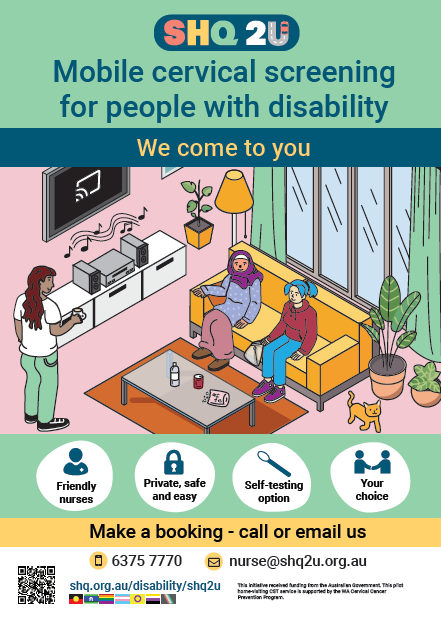
Click image to download PDF
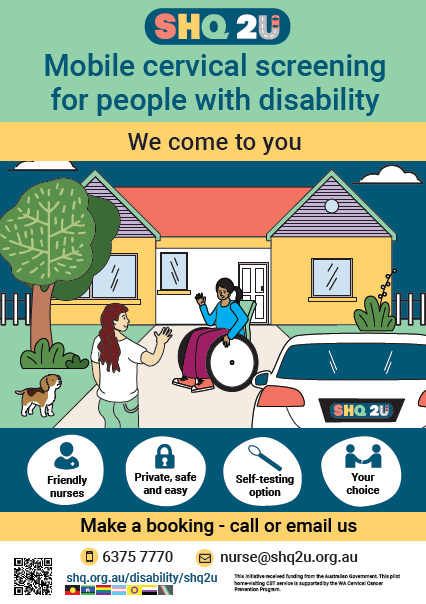
Click image to download PDF
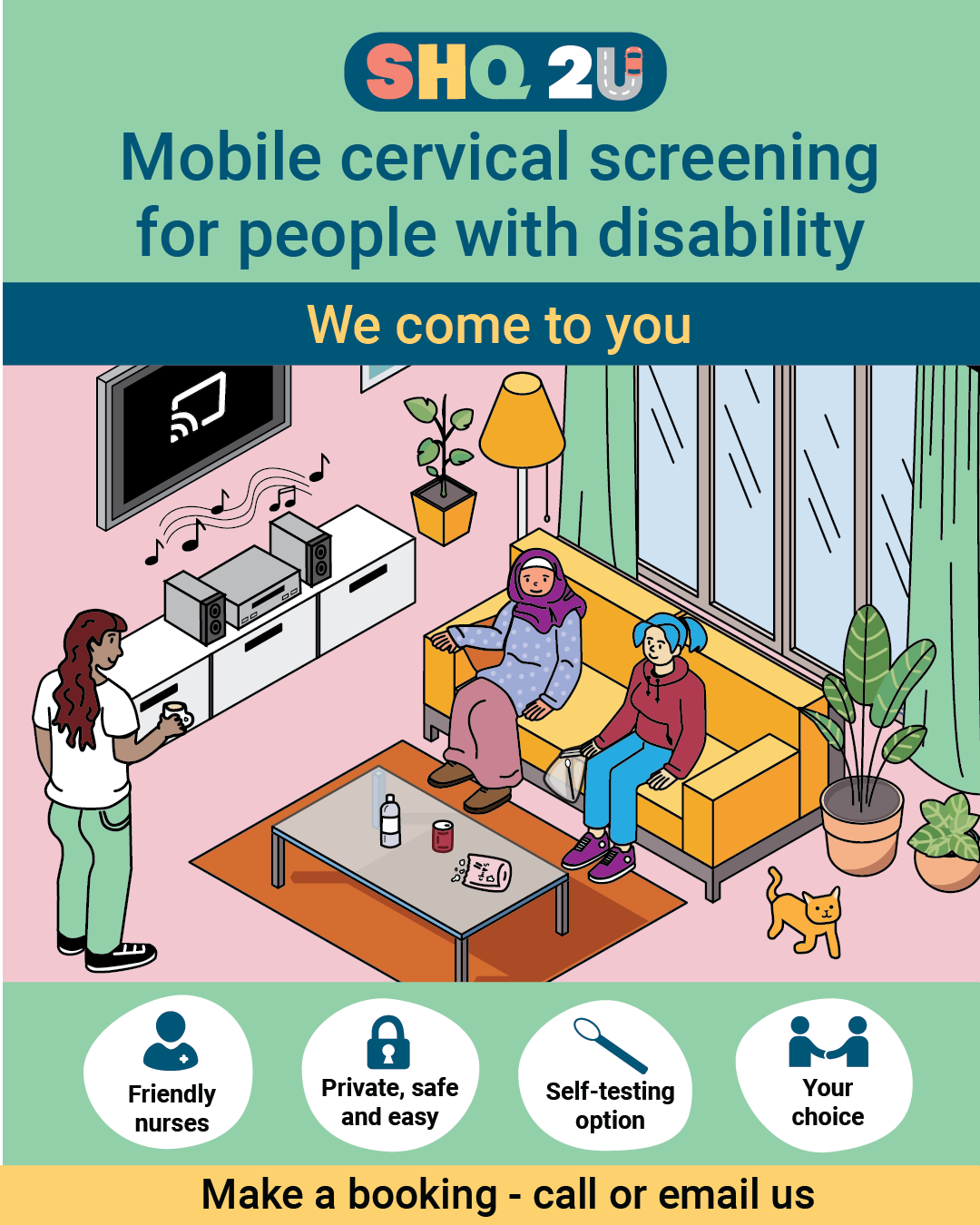
Click image to view full size
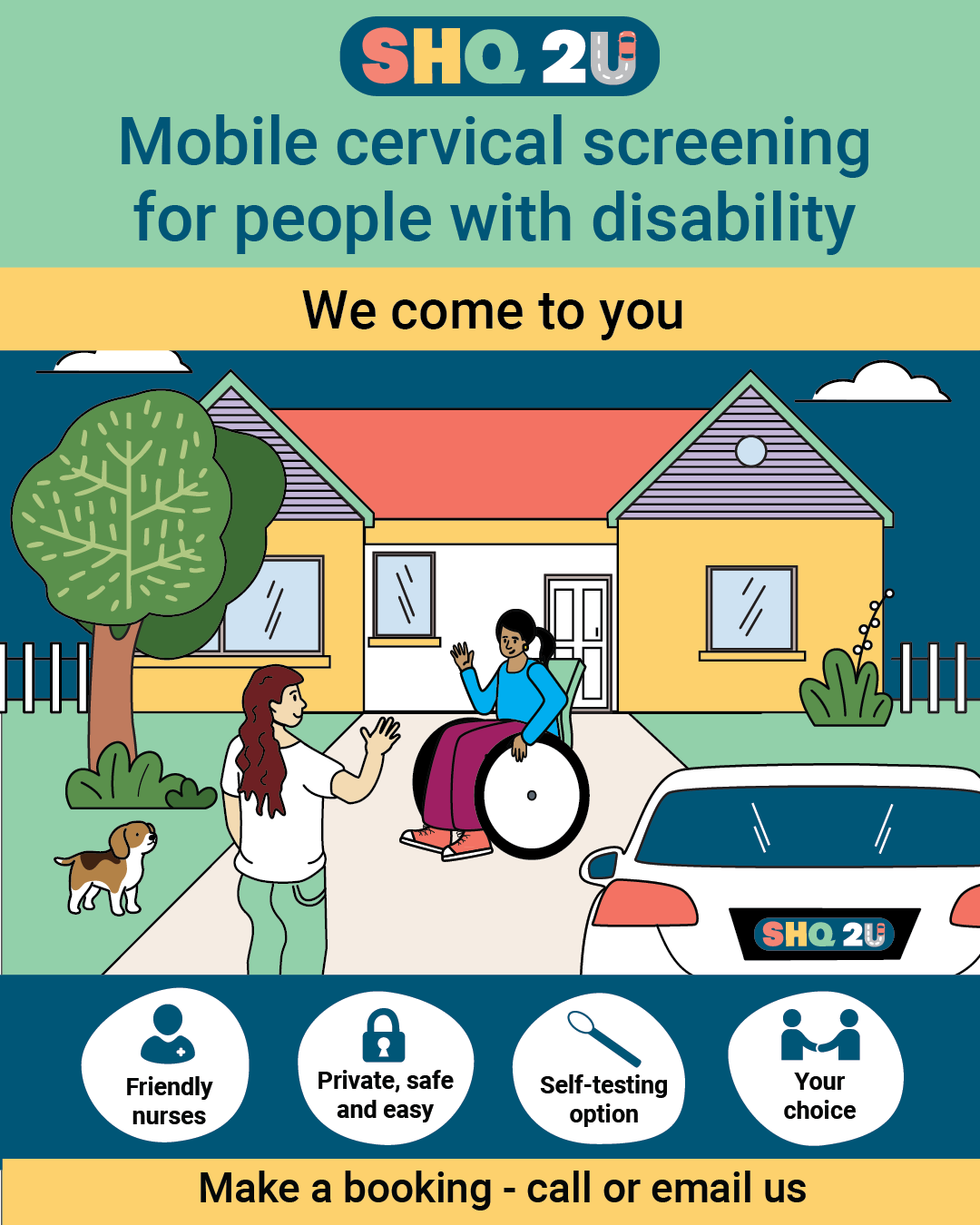
Click image to view full size
- SHQ 2U Easy Read page
- The Cervical Screening Test – Easy Read – National Cervical Screening Program
- The Cervical Screening Test Easy Read Booklet – Screen Equal
- Before my Cervical Screening Test – Screen Equal
- During my Cervical Screening Test – Screen Equal
- After my Cervical Screening Test – Screen Equal
National Cervical Screening Program in Australia
Resources for Aboriginal and Torres Strait Islander women – National Cervical Screening Program From the Department of Health, Disability & Ageing website for Aboriginal and Tores Strait Islander communities
Resources for women from culturally and linguistically diverse backgrounds – National Cervical Screening Program For CaLD communities
What is a cervix?
The cervix is a small round opening that connects the womb to the vagina. It lets blood flow out during a period, makes mucous that helps keep the vagina healthy.
What is HPV?
HPV stands for Human Papillomavirus. It is a common virus that can cause cells in the cervix to grow differently. If these changes are not found early and treated, they can turn into cervical cancer.
How do I get HPV?
You can get HPV from sexual activity with other people. Sexual activity can include vaginal, oral, anal and intimate genital skin contact
What is a cervical screening test?
It is a test that checks that your cervix is healthy. It looks for the HPV and can also check if the cells of your cervix have grown differently.
Do I need to have the test if I have had the HPV vaccine?
Yes. The vaccine protects you from some HPV but not all types.
Do I still need to do the test if I am not sexually active?
Yes, if you have ever had any type of sex, you can have the test.
Who can have the test?
Women and people with a cervix aged 25 to 74, who have had any sexual contact should have a Cervical Screening Test every 5 years.
Do I need to do the test if I have had a hysterectomy (uterus removed)?
You might. Please ask your GP or you can discuss this with the nurse when you phone for an appointment.
How do I know when I need a test?
There are a few options.
- You may have received a letter, email or text message from the government telling you it is time for a test.
- You may have received a reminder letter from your GP.
- You can log in to gov.au website to check the National Cancer Screening Register.
- You can ask your GP or the SHQ 2U nurse to check for you.
How do I make an appointment?
You can contact the SHQ 2U nurse on 6375 7770 to make an appointment or request the nurse to contact you through the Request form.
You can ask a support person to help you.
The nurse will ask some questions about you to help prepare for the appointment.
You can ask the nurse any questions you might have about the appointment.
Can someone else make the appointment for me?
Yes, if you are with them at the time so the nurse can ask you questions.
The nurse will make sure you are included in decisions about your care.
What will happen during my appointment?
You can ask the nurse to see you at home or a community service centre in a private space.
The nurse will explain ways to do the test.
You can choose to either do the test yourself or have the nurse do the test for you.
Can I have someone with me?
Yes. You can ask for support from a partner, family member, friend or carer during the appointment.
If you choose to do the self-collected test, the nurse can assist you if you need help.
Can I say no?
Yes. It is your choice and you can change your mind before or anytime during the appointment.
How will I get my result?
You can discuss with the nurse how you want your results to be given to you.
How long will it take to get my results?
The nurse will let you know when to expect your results.
It usually takes 1-2 weeks.
What does it mean if my result is unsatisfactory or abnormal?
The nurse will explain what your result means and help you understand the next steps. It might mean that you need to have another test with the nurse or that you need to see a doctor for more tests.
You can ask the nurse questions at any time.
Can I also have other tests during my appointment?
No, the service is only for cervical screening test . The nurse can help you with information on where to go for other tests.
I live in shared accommodation and do not feel comfortable having the test at the house.
You can talk to the nurse if you would like the test to be done at another place where you feel comfortable. This can be at a community service centre.